Overview
This project forecasts U.S. Consumer Price Index (CPI) values using a multi-model approach, ranging from classical statistical methods to gradient boosting. The primary objective was to evaluate model accuracy under a rigorous time-series validation framework and demonstrate production-level deployment on AWS SageMaker.
A key decision mid-project was pivoting away from LSTM after testing showed deep learning struggled with the small monthly sample size and non-stationary trend of CPI data — a deliberate architectural choice in favor of a more robust tree-based approach.
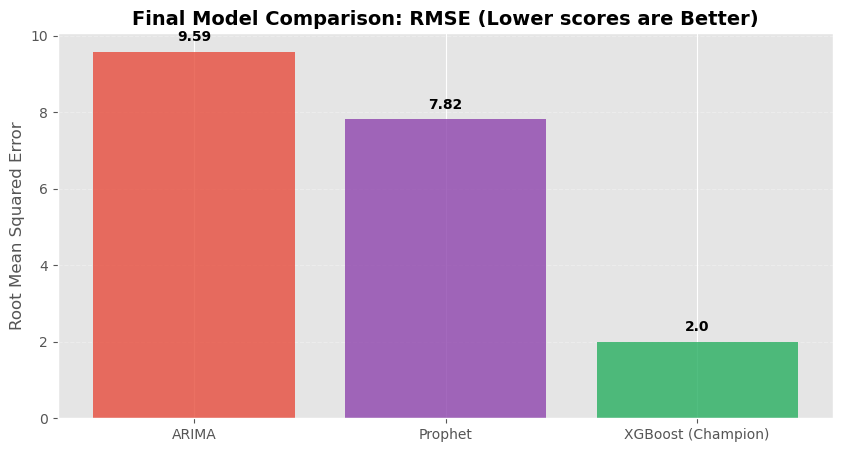
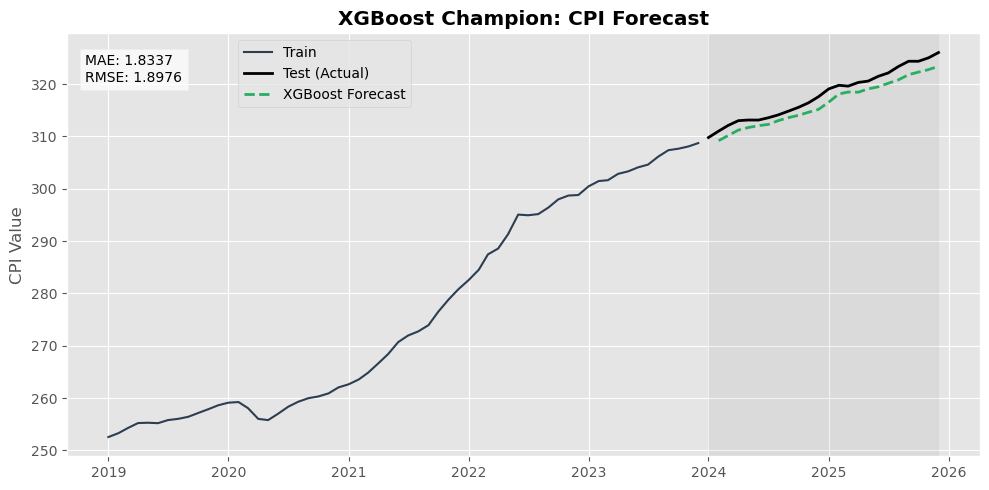
Results
Performance evaluated on a 24-month holdout set (Dec 2023 – Nov 2025):
| Model | MAE | RMSE |
|---|---|---|
| XGBoost (Winner) | 1.83 | 2.0 |
| Prophet | 7.09 | 7.15 |
| ARIMA (1,1,1) | 8.04 | 9.29 |
Data
- Source: Federal Reserve Economic Data (FRED)
- Series: CPIAUCSL (Monthly)
- Evaluation window: 24-month holdout
Technical Approach
- Applied first-order differencing to remove trend bias — model predicts monthly delta rather than absolute CPI values
- Engineered a 12-month sliding window of lag features to capture seasonal momentum and annual cycles
- Benchmarked ARIMA and Prophet as statistical baselines before training XGBoost
- Serialized the final model into
model.tar.gzwith a custom inference handler for SageMaker deployment - Deployment script intentionally separated from the notebook to avoid unnecessary cloud costs
Tech Stack
Python XGBoost ARIMA Prophet AWS SageMaker Boto3 Pandas Scikit-learn FRED API MLOps